Master of Science (MSc) in Physics Program
Welcome│Courses and Quality│Student Life│Visting Students│Research and Faculty│Employment│Events
Courses and Quality
- Program Structure
- Study Plan
- Curriculum and Study Plan
- Program Specification
- Courses Descriptions and Specifications
- Graduation Theses
- Program Learning Outcomes (PLOs)
- Annual Program Reports
- ECTS Workload Assessment
- Student Manual
- Staff Manual
- Program Manual
- Program Quality Management System (QMS) manual
- Surveys
Program Structure:
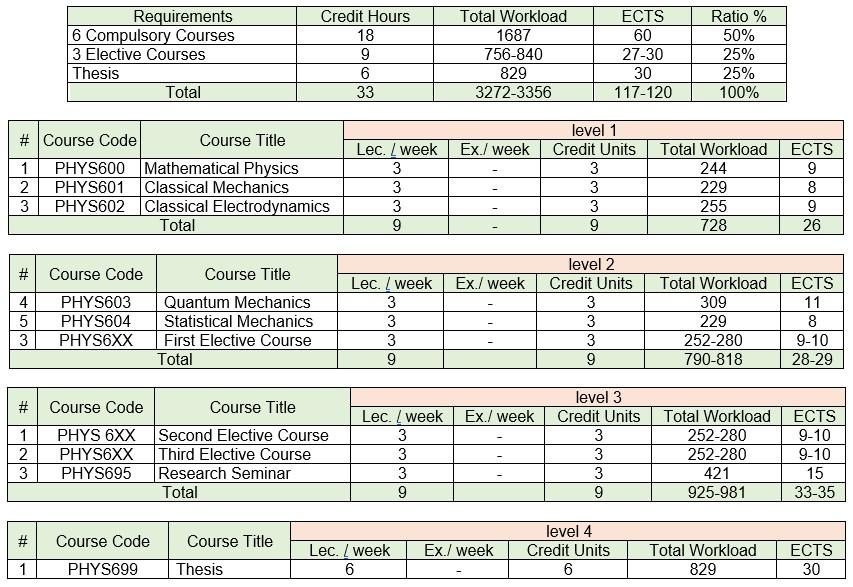
The curriculum of the Master of Science in Physics program is designed for two years, four semesters and consists of 33 credit hours, which is equivalent to 117-120 ECTS points, with sixty ECTS credits for compulsory and thirty ECTS for elective courses, and thirty ECTS credits for the master’s thesis. Ideally, students should take 3 courses each semester during the first 3 semesters and begin their thesis in the fourth semester while completing their studies within 2 years.

Study plan:
The curriculum of Master of Science in Physics program
Courses Descriptions and Specifications
Master Courses Descriptions and Specifications
Compulsory courses
- PHYS600 - Mathematical Physics (CD, CS)
- PHYS601 - Classical Mechanics (CD, CS)
- PHYS602 - Classical Electrodynamics (CD, CS)
- PHYS603 - Quantum Mechanics (CD, CS)
- PHYS604 - Statistical Mechanics (CD, CS)
- PHYS695 - Research Seminar (CD, CS)
Elective courses
- PHYS610 - Computational Physics (CD, CS)
- PHYS611 - Physics Laboratory (CD, CS)
- PHYS620 - Atomic and Molecular Physics (CD, CS)
- PHYS621 - Quantum Optics (CD, CS)
- PHYS622 - Plasma Physics (CD, CS)
- PHYS640 - Solid State Physics (CD, CS)
- PHYS641 - Materials Science (CD, CS)
- PHYS642 - Magnetism and Superconductivity (CD, CS)
- PHYS650 - Nuclear Structure and Spectroscopy (CD, CS)
- PHYS651 - Radiation Physics (CD, CS)
- PHYS660 - Quantum Field Theory (CD, CS)
- PHYS661 - Particle Physics (CD, CS)
- PHYS665 - Selected Topics in Specialized Physics (CD, CS)
Thesis
Graduation Theses
|
Thesis Title |
Researcher's Name |
Supervisor’s Name |
|
|
1 |
Structural Analysis and Luminescence Properties of Ca3Y2B4O12 Doped with Dy and Sm Ions. |
Aziza Qaisi |
Prof. Nurdogan Can |
|
2 |
Stone-Wales Defect in Doped Small Fullerene Cages as Promising Materials for Hydrogen Storage using DFT |
Amatullah Shabi |
Prof. Ahlam EL-Barbary |
|
3 |
Theoretical study of functionalized graphene and fullerene-based sensors for pollutant gases detection |
Iman Al-Dosari
|
Prof. Ahlam EL-Barbary |
|
4 |
Amplitude and phase control of quantum interference in multi-level atoms and their spectral properties |
Eman Mawkali |
Prof. Ali Alkamli Dr. Jabir Hakami |
|
5 |
Exploring the Structural and Luminescent Characteristics of Rare Earth-Doped YCa4O(BO3)3 Phosphors for Dosimetry and Optical Applications. |
Dala Jabli |
Prof. Nurdogan Can Eaysh Madkhali |
|
6 |
Study of Structures and Properties of Pure and Functionalized Nanosheets and Nanocones for Environmental Applications. |
Samia Khurmy |
Prof. Ahlam EL-Barbary Dr Hind Adawi |
|
7 |
Facile synthesis and characterization of transition metal oxide semiconductors for photocatalysis/photobiological applications |
Mariam Ahmed |
Prof. Mohamed Fadhali Dr Nada Masmali |
|
8 |
Quantum Emitter-Mediated Robust Chirality in the Vicinity of Nanophotonic Waveguide. |
Raghad Al-Amri |
Dr. Jabir Hakami |
|
9 |
First principal study of Ti-6AI-4V Optical and mechanical Properties. |
Seham AlFafi |
Dr. Mofareh Ghazwani Dr Hussain athlawi |
|
10 |
New Physics Studies at a Future Electron-Ion Collider Experiment and Development of a High-Performance DIRC Detector for Particle Identification. |
Nada Mahzari |
Dr Afaf Wasely |
|
11 |
Shedding Light on Darkness: Exploration of Fast-Moving Dark Matter |
Aisha Samili |
Dr. Haider Al-Hazmi |
|
12 |
Functionalization of graphene-based nanomaterials to enhance hydrogen storage |
Hanan Madkhali |
Prof. Ahlam EL-Barbary Dr Nada Masmali |
|
13 |
Evaluation of Photoluminescence and Structural Characteristics of YBa3(BO3)3Phosphors Doped with Rare Earth Element. |
Dawah Somali |
Prof. Nurdogan Can Dr. Tahera Zeilaei |
Program Learning Outcomes (PLOs)
Knowledge and Understanding:
- K1. Describe theories, techniques, practices, materials, and terminology relevant to physics topics.
- K2. Discuss physical phenomena and their recent developments in various research fields.
Skills:
- S1. Apply theories and creative solutions to solve physical problems.
- S2. Build critical thinking skills to provide reasonable justification analysis.
- S3. Demonstrate abilities in qualitative and quantitative methods for analyzing and reporting data using computational and IT tools.
- S4.Develop sufficient skills to conduct advanced experimental work and high-level graduate research (theoretical and experimental).
Values, Autonomy, and Responsibility:
- V1. Adhere to the ethical principles and safety requirements.
- V2. Demonstrate ability of independent lifelong learning.
- V3. Show effective individual responsibility and teamwork.
Manuals and reports
- Program Manual
- Student Manual
- Staff Manual
- Quality Management manual
- Policies and Procedures Manual
- Program Quality Management System (QMS) manual
- College of Science Quality Management System (QMS) manual
- Jazan University Quality Management System (QMS) manual
- Annual program reports: 2022-2023, 2023-2024, 2024-2025
- ECTS Workload Report
Surveys:
- Alumni satisfaction survey (ASS)
- Course evaluation survey (CES)
- Employer satisfaction survey (ESS)
- Program evaluation survey (PES)
- Students Experience Survey (SES)
- Supervision Students survey (SSS)
- Student Satisfaction of Research Seminar (SSRS)
- Student Satisfaction of Thesis (SST)
- Faculty Members Survey (FMS)
To view the surveys, click here.